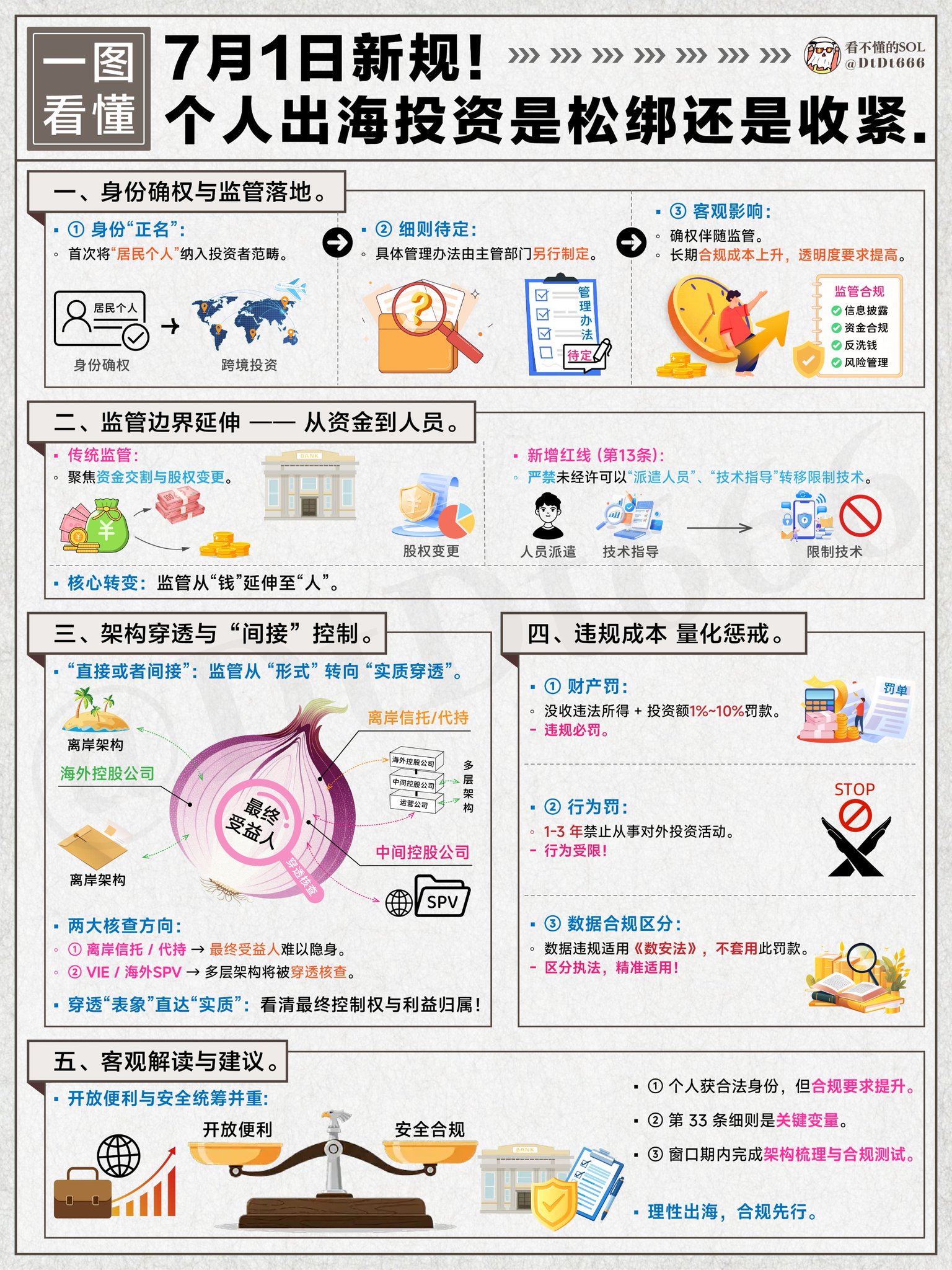
The new rule arrives on July 1! Is personal overseas investment getting looser or tighter?
Recently the State Council officially issued the "Regulations on Outward Investment," the first administrative regulation specifically governing overseas investment, effective from July 1. In short, this time residents are formally brought under regulatory scope—previously it mainly covered enterprises, now personal overseas investment must also follow the new rules. The overall direction supports reasonable overseas expansion while strengthening compliance supervision, shifting from a gray area to clear rules.
What does the new rule mainly cover?
1️⃣ First time personal identity is clarified: residents making cross‑border investments must verify their identity. Future information disclosure, source of funds, anti‑money‑laundering requirements will be stricter, and compliance costs will certainly rise.
2️⃣ Expanded supervision scope: it’s not just about money and equity, it also extends to “people.” For example, without permission, you cannot arbitrarily send personnel or provide technical guidance to transfer restricted technology.
3️⃣ Transparent (penetrative) supervision: focus on "direct or indirect" control. Offshore companies, trusts, VIEs, multi‑layer SPVs, etc., will be examined for who the ultimate controller and beneficiary are; superficial forms are useless, substance matters.
4️⃣ Penalties are clearer:
Fines: confiscation of illegal gains + a fine of 1%‑10% of the investment amount.
Investment ban: severe cases may be barred from any outward investment for 1‑3 years.
Overall, it’s not a blanket ban on going overseas; it turns previous gray areas white, making the compliance path clearer, but the cost of violations is significantly higher.
Impact on ordinary mainland users
1️⃣ Going forward, personal purchases of overseas real estate, stocks, funds, company establishment, trusts, etc., all count as outward investment.
2️⃣ The annual $50,000 foreign‑exchange quota cannot be used for these capital‑item investments; the risk of using gray‑channel routes is now higher.
3️⃣ In the short term the detailed rules are not fully released, so there won’t be an immediate massive reporting requirement, but the supervisory framework is in place and penetrative review will be gradually strengthened.
Suggestion: If you have an overseas plan, tidy up your structure during the window period, ensure the ultimate beneficiaries are clear and funds are legitimate. It’s best to go through formal channels such as QDII—compliance first, operate rationally.
Impact on crypto‑community users
1️⃣ Although the new rule does not explicitly name cryptocurrencies, the impact is significant because they have always been a strictly supervised field (the September 24 2021 notice already classified them as illegal financial activities).
2️⃣ After the new rule overlaps:
Using offshore exchanges, wallets, DeFi positions or trades can be seen as “indirect overseas investment,” and hidden structures are more likely to be examined under penetrative supervision.
3️⃣ Large‑scale fund flows (especially USDT and similar), technical support, project promotion, etc., will face tighter foreign‑exchange and AML scrutiny.
4️⃣ If deemed non‑compliant, beyond previous penalties you may also face additional asset fines and a 1‑3‑year investment ban.
Practical advice:
Retail investors: low‑key holding is generally fine, but avoid frequent large transactions; keep fund sources clean.
Project teams, KOLs, practitioners: be especially cautious when providing services or technical output to domestic users.
The overall trend is a further shrinkage of gray space; we strongly recommend following compliant paths first, and if unsure, consult a professional lawyer.
In summary, after July 1 compliance becomes the key. Legitimate overseas activity is still possible, but transparency and standardization requirements have increased. Crypto friends need to be extra cautious, avoid complacency. The policy aims to regulate the market, not to shut it down completely; stay rational, prepare in advance.