 Sky (SKY)
- 47ソーシャル・センチメント・インデックス(SSI)- (24h)
- #60マーケット・パルス・ランキング(MPR)0
- 124時間ソーシャルメンション- (24h)
- 100%24時間のKOL強気比率1人のアクティブなKOL
- 概要SKY benefits from Spark's multi-layer risk protection and a $15 billion fund, with price up 4.47% in 24h.
- 強気のシグナル
- Multi-layer security protection
- US$15 billion fund
- Price up 4.47%
- Community confidence rising
- Spark primary reserve
- 弱気のシグナル
- Loan default risk
- Issuance of new SKY dilutes
- Complex model vulnerabilities
- Overall market loopholes
- Depositors are the last to be hurt
ソーシャル・センチメント・インデックス(SSI)
- データ全体47SSI
- SSIトレンド(7日間)価格(7日間)センチメントの分布非常に強気 (100%)SSIインサイトSKY social heat is moderate (46.56/100), sentiment is positive 30/30 driving the highest, KOL attention is only 1/30, boosted by a 4.47% price rise and a $15 billion fund.
マーケット・パルス・ランキング(MPR)
- アラートインサイトSKY warning rank #60, sentiment polarization at the maximum 100/100, social anomaly at 41.43/100, KOL attention shift low at 1/100, reflecting price rise and risk controversy.
Xへの投稿
 DeFi Warhol DeFi_Expert OnChain_Analyst B51.94K @Defi_Warhol
Protocols tend to explain their risk model after something fails. @sparkdotfi publishing its full risk playbook now feels like a pretty confident move, especially while the market is still dealing with exploits and shutdowns. Basically, when a loan goes bad and someone has to cover it, depositors are usually the first ones to take a loss. Spark made it so they're the last in line during a scenario like this. It's a meaningful design choice for their entire community. Let's see how they handle these worst-case scenarios in-depth ↓ 1/ Loss absorption model Losses are covered in this order before depositors are affected: → Spark's own reserves → Outside investors → Protocol's savings → A shared safety fund across the wider Sky Ecosystem → Newly minted SKY (as a final backstop) For user deposits to take a hit, all of those protection layers would have to be wiped out first, and that's highly unlikely. Spark is also adding more protection for depositors. @SkyEcosystem recently put $150M into a dedicated reserve instead of using it for SKY buybacks, giving Spark another buffer before user deposits start getting affected in a worst-case scenario. A security model with so many defensive layers for users is a pretty rare sight in DeFi, at least for me. 2/ Asset containment All of these protection layers are a backup plan. Spark's design is mostly about making sure it never has to use them. A lot of its yield comes from moving idle stablecoins around, and most of that is automated. So the obvious question is, what happens if someone hijacks it? The automation can only send funds to pre-approved places, and only in limited amounts. So even if someone somehow got control, they wouldn’t be able to drain the whole system. They’d be stuck moving tiny amounts into the same audited venues Spark already uses. The same approach applies to bridge exposure, which is one of the most common sources of major crypto exploits. Spark deliberately caps its bridge exposure at around $2M, even though the protocol itself holds billions. 3/ Pricing without single points of failure The other place lending protocols usually break is pricing. Most lending hacks are just fake value attacks. They make collateral look more valuable than it is and borrow real assets against it, leaving the protocol stuck with holding the worthless asset. Spark makes this process super difficult by: → Not relying on one price source → Adding extra protection around assets that are more likely to drift from their expected value (staked ETH, wrapped Bitcoin) That’s the whole point of this pricing system: bad collateral shouldn’t be allowed to turn into debt for the rest of the users. 4/ A live stress test Risk frameworks sound nice on paper. But the real question is what happens when they get tested in a real scenario. Earlier this year, rsETH ran into serious trouble after a lot of lending markets had already accepted it as collateral. Spark had cut rsETH months before the trouble started, so the damage never reached its system. That was well-timed risk management. Over the past year, Spark has been steadily removing older, smaller, and lower-usage markets. The whole thing comes down to one word: containment. When something breaks (and in crypto, something always eventually does), the damage should be contained as much as possible. The infrastructure underneath Spark has run for the better part of a decade without a single known smart contract exploit, which is quite rare in DeFi. On top of that, the Spark Savings vaults are independently rated by Credora. Of course, none of this makes Spark unbreakable. But after watching so many protocols run with weak risk plans, or no real plan at all, I respect how seriously Spark seems to take this side of the product. Other protocols should take notes.
 Spark D69.99K @sparkdotfi
Inside Spark’s loss absorption & risk frameworks. Spark’s security architecture is designed around: • bounded capital movement • explicit loss absorption layers • coordinated liquidity management • multi-layered oracle systems • constrained automation under governance-defined limits This deep dive breaks down how Spark structures risk, liquidity, and loss absorption across Spark Savings, SparkLend, and the Spark Liquidity Layer before losses propagate toward user deposits. Including: • updated loss absorption waterfall • Prime Agent risk capital • Genesis Capital Backstop • oracle and killswitch architecture • programmatic liquidity coordination • constrained allocation design under stress Security by design. Resilience by architecture. See what sits between losses and user deposits: https://t.co/JQrfSxMB4z
87 8 6.47K オリジナル >リリース後のSKYのトレンド非常に強気Spark protocol releases a comprehensive risk model, showcasing its outstanding security design, which other protocols should learn from. Cyriptoman4 TA_Analyst Trader B27.93K @Cyriptoman4
#SKY as expected the pullback came. 0,070 $ was the level I was watching. It fell below support. I will keep an eye on it for a while longer. https://t.co/BigBuzOHPm
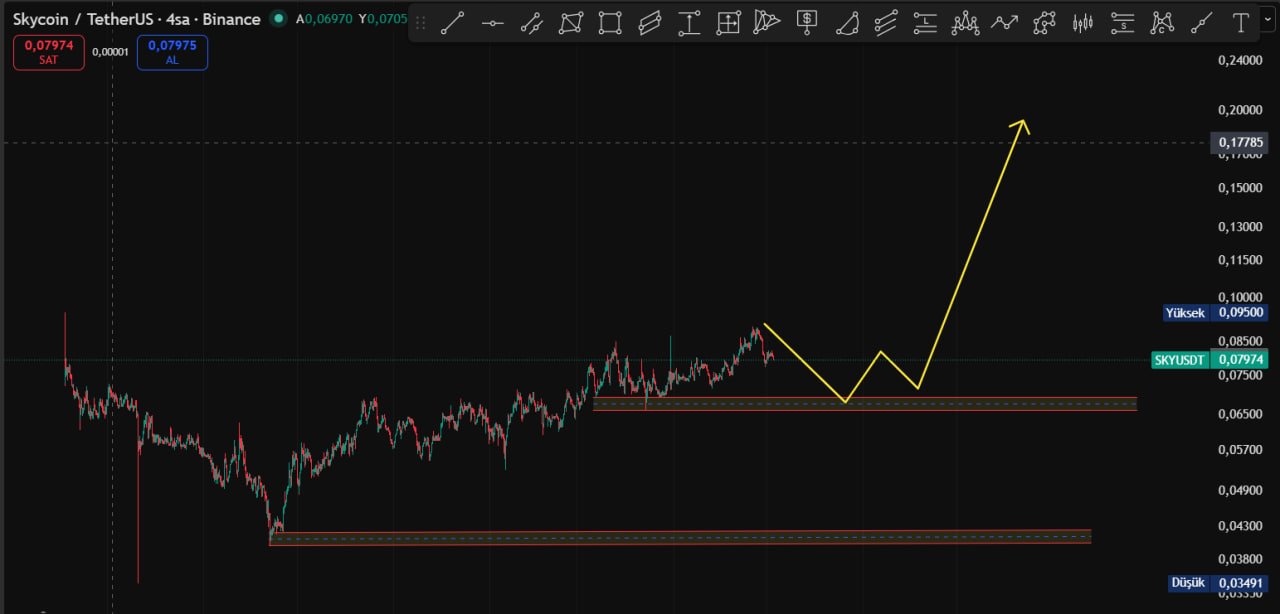
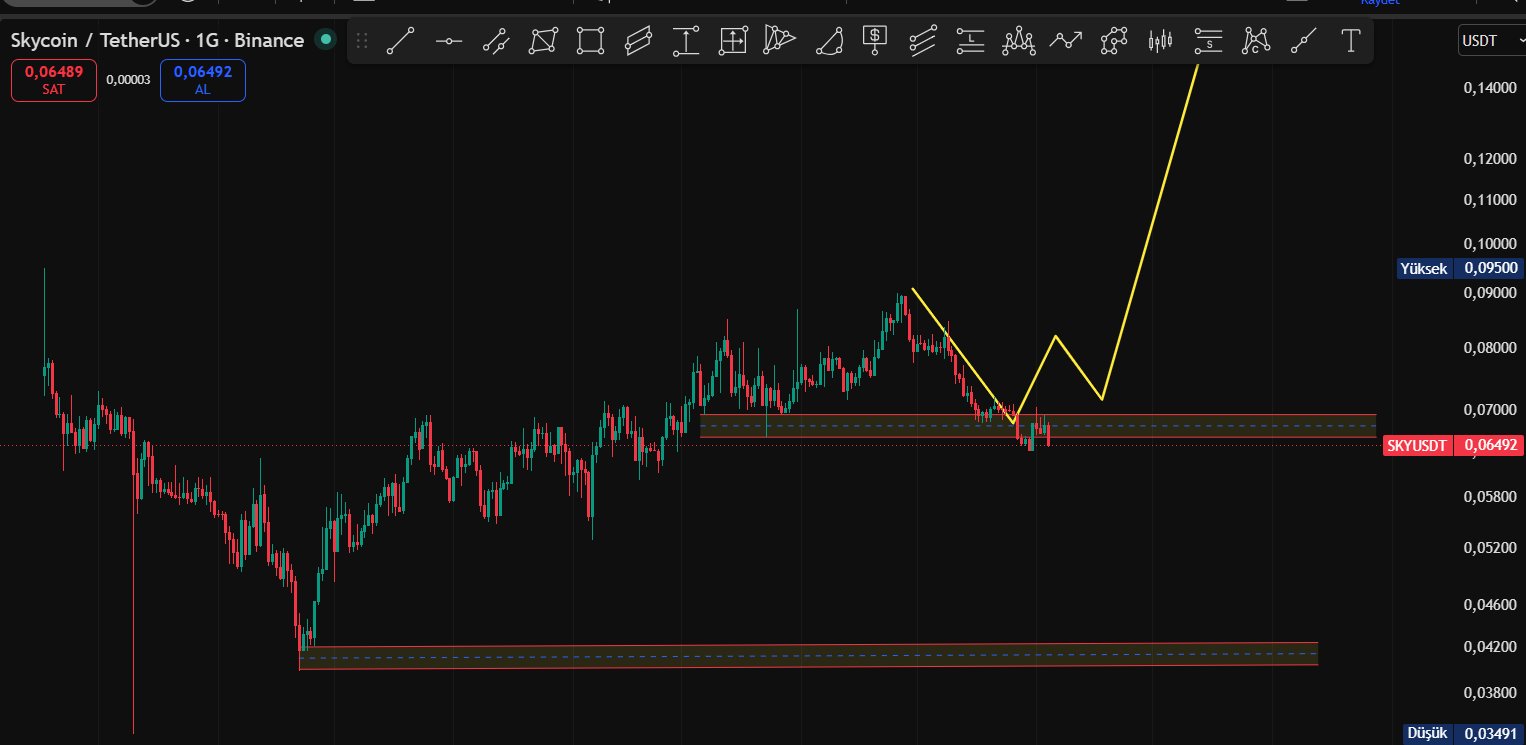 62 1 1.46K オリジナル >リリース後のSKYのトレンド強気SKY pulled back below 0.070, and the author expects a significant rally after short-term consolidation.
 slappjakke FA_Analyst Tokenomics_Expert C61.01K @Slappjakkeslappjakke FA_Analyst Tokenomics_Expert C61.01K @Slappjakke
When reviewing a DeFi protocol security should always be in mind. Moneymarkets are spending millions on audits, and have Risk Teams monitoring and reviewing collateral assets, but do you know who's first in line to absorb losses if funds are actually lost in the protocols you deploy your assets into? @sparkdotfi SparkLend breaks down the waterfall of loss absorption through 5 layers Layer 1: Prime Agent Risk Capital Spark eats its own losses first through internal treasury capital, then pulls in external junior money, and only after that touches the senior layer Layer 2: Surplus Buffer Protocol fees and liquidation revenue pile up here as a system-wide shock absorber Layer 3: Genesis Capital Backstop New layer (pending governance) where excess capital sitting idle across the Sky ecosystem gets tapped before SKY dilution kicks in Layer 4: Sky Token Backstop If everything above is depleted, the protocol mints SKY to recapitalize. Minting SKY is governance-controlled and designed for genuine tail scena
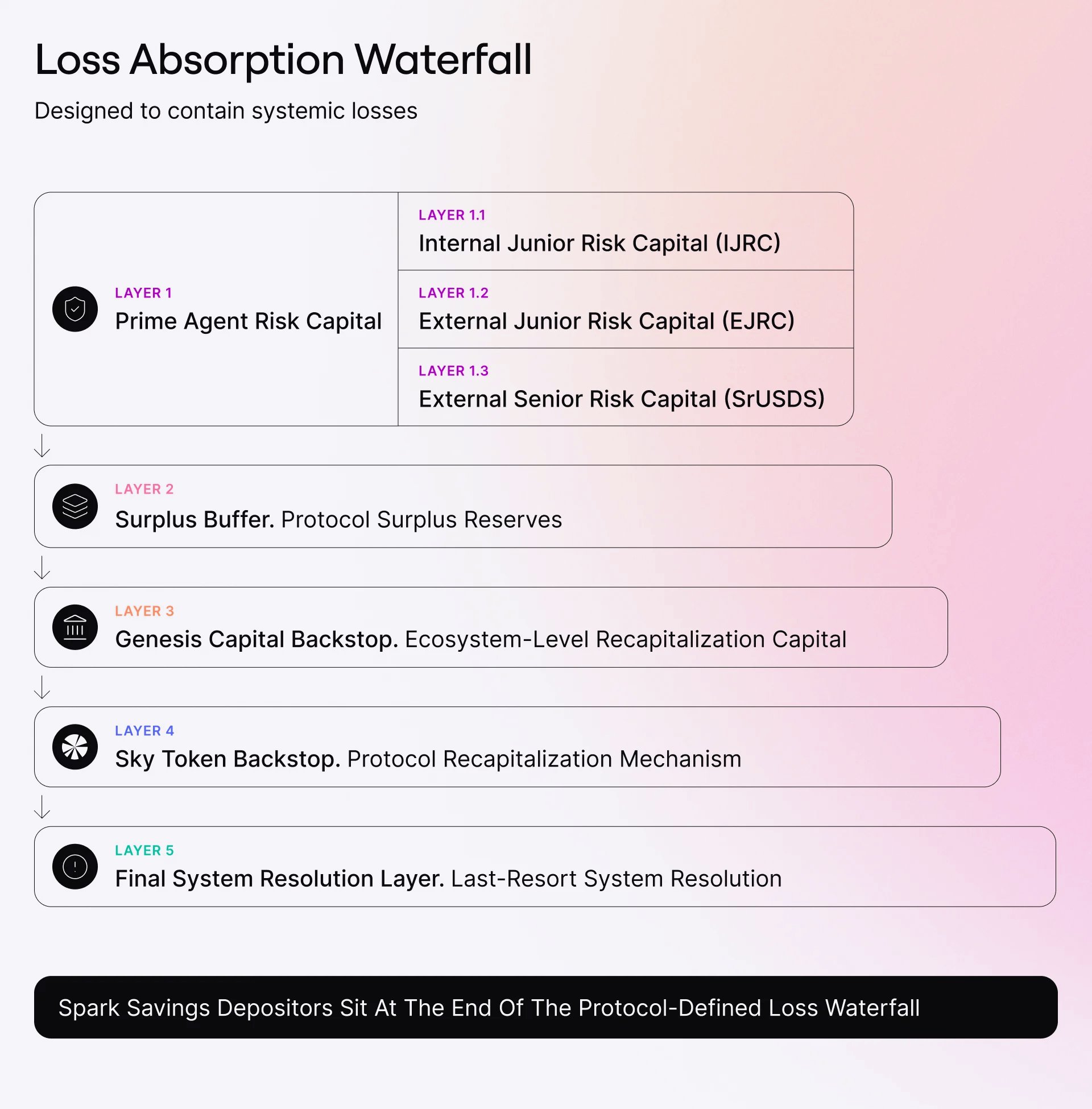 49 12 1.85K オリジナル >リリース後のSKYのトレンド強気SparkLend enhances protocol security and protects depositor funds through a five-layer loss absorption mechanism.
 Eli5DeFi DeFi_Expert OnChain_Analyst C46.16K @Eli5defiEli5DeFi DeFi_Expert OnChain_Analyst C46.16K @Eli5defi
Spark just published one of the clearer security frameworks in scaled DeFi. Not through vague “security” claims, but through a proper loss absorption waterfall. In simple terms: It explains how losses are absorbed before they reach user deposits across Spark Savings, SparkLend, and the Spark Liquidity Layer. That matters more after the latest wave of DeFi exploits. The recent KelpDAO rsETH exploit showed how one weak cross-chain component can spread stress across lending markets, trigger emergency freezes, and turn “isolated risk” into ecosystem-wide liquidity pressure. This is exactly why explicit risk design matters. Spark’s core idea is bounded capital movement → Explicit loss hierarchy → Programmatic liquidity coordination → Multi-oracle safeguards → Governance-constrained automation. In plain english: → Losses flow in order: prime agent capital, surplus buffer, genesis backstop, sky backstop, then final resolution → Only approved collateral; depegs can trigger emergency shutdown via special pri
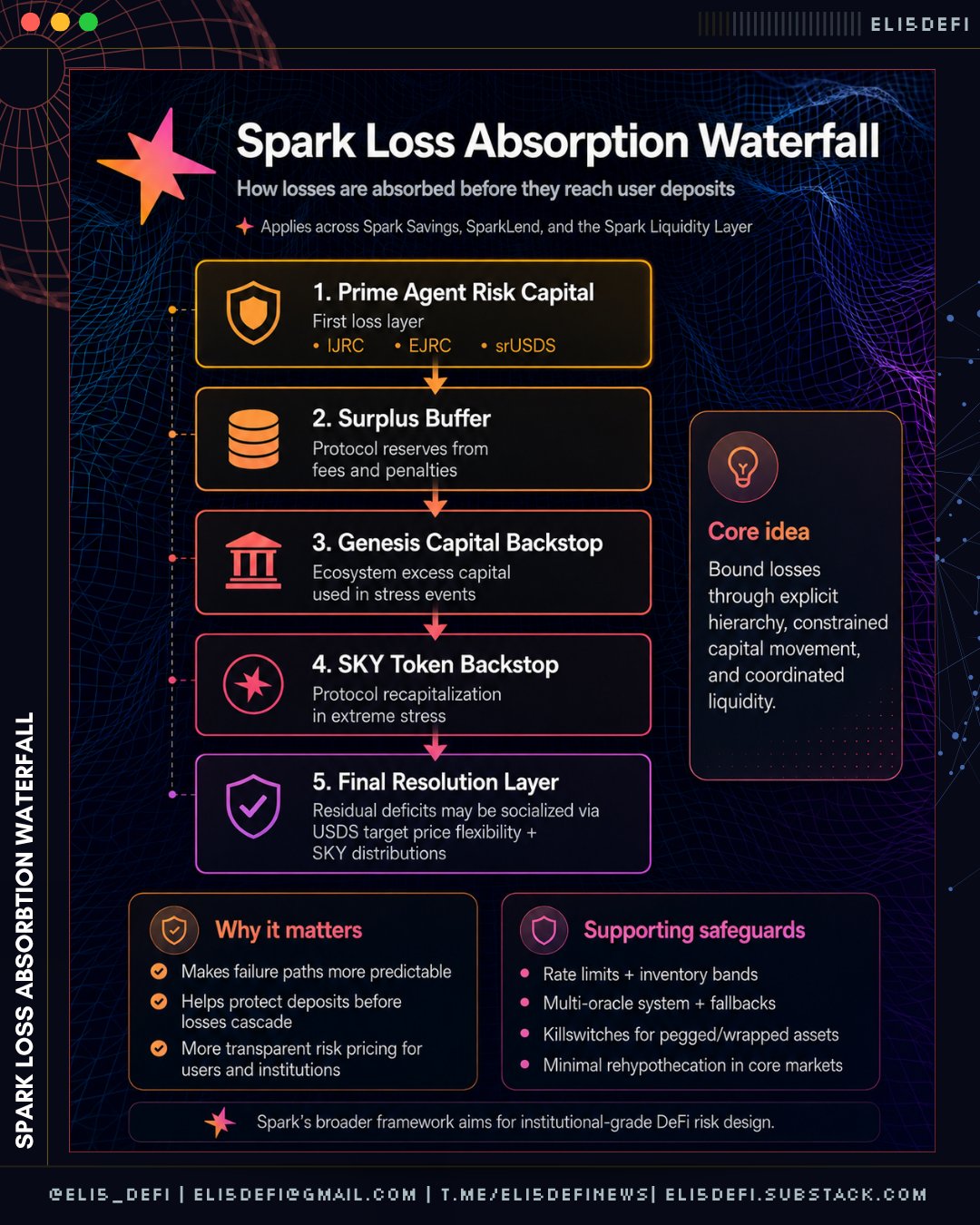 38 19 2.96K オリジナル >リリース後のSKYのトレンド強気Spark has released a clear loss absorption framework aimed at protecting user deposits from DeFi risk.
- Eli5DeFi DeFi_Expert OnChain_Analyst C46.16K @Eli5defiEli5DeFi DeFi_Expert OnChain_Analyst C46.16K @Eli5defi
Spark just published one of the clearer security frameworks in scaled DeFi. Not through vague “security” claims, but through a proper loss absorption waterfall. In simple terms: It explains how losses are absorbed before they reach user deposits across Spark Savings, SparkLend, and the Spark Liquidity Layer. That matters more after the latest wave of DeFi exploits. The recent KelpDAO rsETH exploit showed how one weak cross-chain component can spread stress across lending markets, trigger emergency freezes, and turn “isolated risk” into ecosystem-wide liquidity pressure. This is exactly why explicit risk design matters. Spark’s core idea is bounded capital movement → Explicit loss hierarchy → Programmatic liquidity coordination → Multi-oracle safeguards → Governance-constrained automation. In plain english: → Losses flow in order: prime agent capital, surplus buffer, genesis backstop, sky backstop, then final resolution → Only approved collateral; depegs can trigger emergency shutdown via special pri
38 19 2.96K オリジナル >リリース後のSKYのトレンド非常に強気Spark releases a clear DeFi security framework to protect user funds. - slappjakke FA_Analyst Tokenomics_Expert C61.01K @Slappjakke
When reviewing a DeFi protocol security should always be in mind. Moneymarkets are spending millions on audits, and have Risk Teams monitoring and reviewing collateral assets, but do you know who's first in line to absorb losses if funds are actually lost in the protocols you deploy your assets into? @sparkdotfi SparkLend breaks down the waterfall of loss absorption through 5 layers Layer 1: Prime Agent Risk Capital Spark eats its own losses first through internal treasury capital, then pulls in external junior money, and only after that touches the senior layer Layer 2: Surplus Buffer Protocol fees and liquidation revenue pile up here as a system-wide shock absorber Layer 3: Genesis Capital Backstop New layer (pending governance) where excess capital sitting idle across the Sky ecosystem gets tapped before SKY dilution kicks in Layer 4: Sky Token Backstop If everything above is depleted, the protocol mints SKY to recapitalize. Minting SKY is governance-controlled and designed for genuine tail scena
49 12 1.85K オリジナル >リリース後のSKYのトレンド非常に強気SparkLend enhances protocol security and protects depositor funds through a five-layer loss absorption mechanism. - Eli5DeFi DeFi_Expert OnChain_Analyst C46.16K @Eli5defiEli5DeFi DeFi_Expert OnChain_Analyst C46.16K @Eli5defi
Spark just published one of the clearer security frameworks in scaled DeFi. Not through vague “security” claims, but through a proper loss absorption waterfall. In simple terms: It explains how losses are absorbed before they reach user deposits across Spark Savings, SparkLend, and the Spark Liquidity Layer. That matters more after the latest wave of DeFi exploits. The recent KelpDAO rsETH exploit showed how one weak cross-chain component can spread stress across lending markets, trigger emergency freezes, and turn “isolated risk” into ecosystem-wide liquidity pressure. This is exactly why explicit risk design matters. Spark’s core idea is bounded capital movement → Explicit loss hierarchy → Programmatic liquidity coordination → Multi-oracle safeguards → Governance-constrained automation. In plain english: → Losses flow in order: prime agent capital, surplus buffer, genesis backstop, sky backstop, then final resolution → Only approved collateral; depegs can trigger emergency shutdown via special pri
38 19 2.96K オリジナル >リリース後のSKYのトレンド強気Spark releases a DeFi loss-absorption framework, protecting user deposits through multi-layer safeguards. - Eli5DeFi DeFi_Expert OnChain_Analyst C46.16K @Eli5defiEli5DeFi DeFi_Expert OnChain_Analyst C46.16K @Eli5defi
Spark just published one of the clearer security frameworks in scaled DeFi. Not through vague “security” claims, but through a proper loss absorption waterfall. In simple terms: It explains how losses are absorbed before they reach user deposits across Spark Savings, SparkLend, and the Spark Liquidity Layer. That matters more after the latest wave of DeFi exploits. The recent KelpDAO rsETH exploit showed how one weak cross-chain component can spread stress across lending markets, trigger emergency freezes, and turn “isolated risk” into ecosystem-wide liquidity pressure. This is exactly why explicit risk design matters. Spark’s core idea is bounded capital movement → Explicit loss hierarchy → Programmatic liquidity coordination → Multi-oracle safeguards → Governance-constrained automation. In plain english: → Losses flow in order: prime agent capital, surplus buffer, genesis backstop, sky backstop, then final resolution → Only approved collateral; depegs can trigger emergency shutdown via special pri
38 19 2.96K オリジナル >リリース後のSKYのトレンド強気Spark released a clear DeFi security framework that protects user deposits through a multi-layer loss absorption mechanism. - Eli5DeFi DeFi_Expert OnChain_Analyst C46.16K @Eli5defi
Spark just published one of the clearer security frameworks in scaled DeFi. Not through vague “security” claims, but through a proper loss absorption waterfall. In simple terms: It explains how losses are absorbed before they reach user deposits across Spark Savings, SparkLend, and the Spark Liquidity Layer. That matters more after the latest wave of DeFi exploits. The recent KelpDAO rsETH exploit showed how one weak cross-chain component can spread stress across lending markets, trigger emergency freezes, and turn “isolated risk” into ecosystem-wide liquidity pressure. This is exactly why explicit risk design matters. Spark’s core idea is bounded capital movement → Explicit loss hierarchy → Programmatic liquidity coordination → Multi-oracle safeguards → Governance-constrained automation. In plain english: → Losses flow in order: prime agent capital, surplus buffer, genesis backstop, sky backstop, then final resolution → Only approved collateral; depegs can trigger emergency shutdown via special pri
Spark D69.99K @sparkdotfiInside Spark’s loss absorption & risk frameworks. Spark’s security architecture is designed around: • bounded capital movement • explicit loss absorption layers • coordinated liquidity management • multi-layered oracle systems • constrained automation under governance-defined limits This deep dive breaks down how Spark structures risk, liquidity, and loss absorption across Spark Savings, SparkLend, and the Spark Liquidity Layer before losses propagate toward user deposits. Including: • updated loss absorption waterfall • Prime Agent risk capital • Genesis Capital Backstop • oracle and killswitch architecture • programmatic liquidity coordination • constrained allocation design under stress Security by design. Resilience by architecture. See what sits between losses and user deposits: https://t.co/JQrfSxMB4z
38 19 2.96K オリジナル >リリース後のSKYのトレンド非常に強気Spark has released a clear loss absorption framework aimed at protecting user deposits from DeFi risk.  吴说区块链 Media Educator D177.49K @wublockchain12
Wu says he learned that, according to on-chain analyst余烬 monitoring, a suspected Dragonfly‑related address transferred 137 million SKY to Coinbase 10 minutes ago, worth about $9.05 million.余烬 stated that the SKY associated with this address likely originated from a conversion of MKR holdings moved from Binance in August 2021, which was worth about $20.45 million at the time; it has now shrunk by more than half, valued at about $9.05 million. https://t.co/3SE9T1jLit
1 2 2.17K オリジナル >リリース後のSKYのトレンド弱気SKY transferred to Coinbase, value shrank by more than half, indicating increased selling pressure.