We are always open to reasonable, well-grounded debate, especially when it happens in a polite and constructive way. This is exactly what Web3 needs more of.
@Trunnik was one of the few people who tried to show the situation from both sides, and we thank him for that.
The market is not in its best stage right now, and we understand the frustration. But being reasonable, thinking critically, and looking at situations from multiple angles is what is required to succeed in any space, especially in a financial one.
Since his post already covered the part about decision-making accountability and risk awareness, we won’t add anything further on that.
People make financial decisions based on their own risk profile, analysis, and expectations. At least, that is how it is supposed to work.
What we would like to add is our perspective, so the situation is clearer from our side.
CookieDAO was indeed significantly affected by X’s decision.
We did not control that decision. We could not control it. As for claims that we knew about it in advance, everyone is free to form their own view, but we do not believe speculation deserves further comment.
We understand the perspective of people who were affected by this. At the same time, it is important to also look at the situation from the business side.
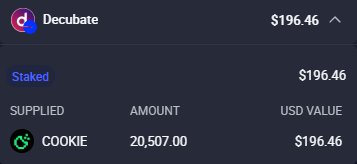
The original logic was that KOLs staked COOKIE in exchange for mindshare boosts. Those boosts no longer exist because the campaign structure changed after X’s decision.
However, users did receive those boosts for the campaigns that had already taken place, based on the amount they staked and the duration of their lock-up. Some participated for a longer period, some for a shorter one, but rewards were distributed in accordance with the staking structure that existed at the time.
They also received rewards connected to those boosted campaigns.
That is why our thinking was the following: releasing the stake early would have created an unfair outcome.
Users would have received boosted rewards based on a longer lock-up, while no longer respecting the lock-up period that gave them access to that higher boost in the first place.
Naturally, no one wanted to return already received rewards. At the same time, many expected the situation to be resolved only in their favor, while leaving the project itself in a vulnerable position.
The duration of the stake directly influenced the reward boost. A longer lock-up meant a larger boost. The same boost could also have been achieved by staking more COOKIE for a shorter period if users were concerned about committing to a longer lock-up.
There was never a guaranteed number of campaigns promised, nor a guaranteed duration for how long those campaigns would continue.
From our perspective, users made a risk-based decision when choosing a longer staking period in exchange for a stronger boost.
We fully understand why this became frustrating after the external situation changed. But the original structure was built around that risk-reward tradeoff, and that context matters when evaluating the situation fairly.
This is not about dismissing anyone’s frustration.
It is about explaining why the situation was not as one-sided as it may look from the outside.
We are not running away from our past. We are not going silent. We are simply focusing on what we can control now, and that is continuing to build.
Business decisions are tough. Sometimes you end up in a position where there are no perfect solutions, only difficult choices. And even then, you still have to make a decision if you want the project to survive.
We don’t blame anyone. We don’t want to point fingers.
We understand the frustration, and we also understand that not everyone will see the situation the same way.
But our focus now is on building, improving, and moving the space forward. That is the only productive path from here.
To everyone who criticizes us: sincerely, thank you. You really do make us stronger.
And to everyone who is still with us: we love you.
You are the best part of this journey.
We’ll keep pushing forward.