Bitcoin fear & greed: 9.
You already know what to do. https://t.co/msg0DlnnCz


 1.6M @cryptorover
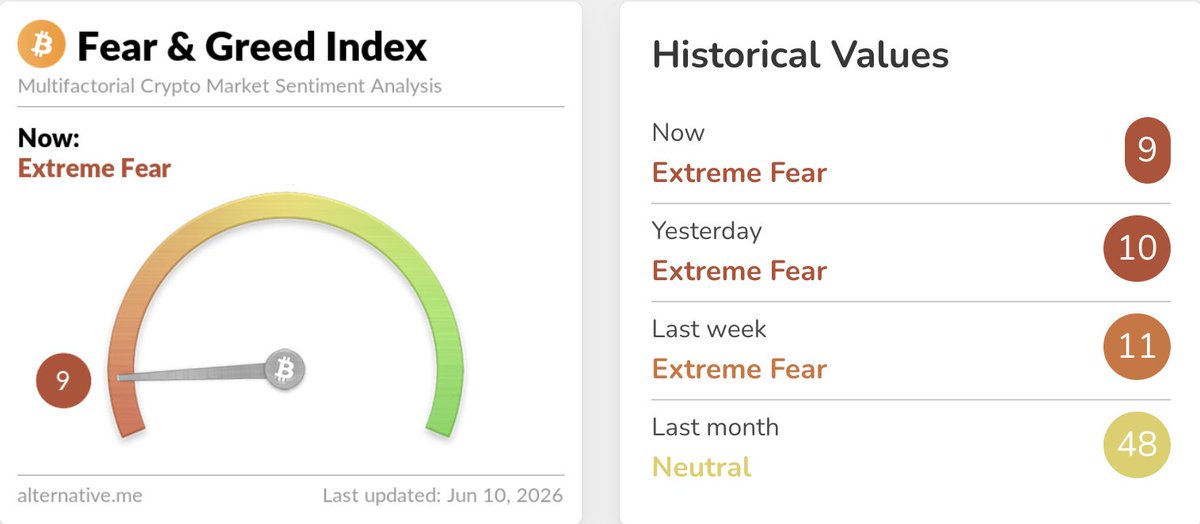
 Bitcoin fear & greed: 9.
You already know what to do. https://t.co/msg0DlnnCz
 9
9
 10
10
 380
380
 101.4K @MilkRoad 101.4K @MilkRoad
 Saylor: "If you walk down the street and ask people, 'Do you want a bank account that pays you 11% that the government won't tax?'"
"Everybody's answer is, 'Of course I want that. What's the catch?'
The catch is it's new. The real risk is simple:
If you think Bitcoin goes to zero, don't buy it - it's like owning credit on a Manhattan building.
You lose money if "Manhattan sinks underneath the ocean," but not under normal conditions.
FT @Saylor @Sam_Vadas @SchwabNetwork.
98
20
63.5K
 82.9K @AdamBLiv
 We have to be near a Bitcoin bottom if we have Bitcoin maximalists using fiat credit risk frameworks to evaluate the credit risk of STRC.
"I am a Bitcoin maxi, let me cite S&P Global who counts $52 billion of Bitcoin as zero."
The FUD is insane. Bitcoin is going to win and therefore Strategy is going to win.
The preferences of individuals are irrelevant in the grand scheme of things.
13
3
271

Bitcoin (BTC) is a digital asset and a payment system invented by Satoshi Nakamoto who published a related paper in 2008 and released it as open-source software in 2009. The system featured as peer-to-peer; users can transact directly without an intermediary. Transactions are verified by network nodes and recorded in a public distributed ledger called the blockchain. The ledger uses bitcoin as its unit of account. The system works without a central repository or single administrator, which has led the U.S. Treasury to categorize bitcoin as a decentralized virtual currency. Bitcoin is often called the first cryptocurrency, although prior systems existed. Bitcoin is more correctly described as the first decentralized digital currency. It is the largest of its kind in terms of total market value by now.