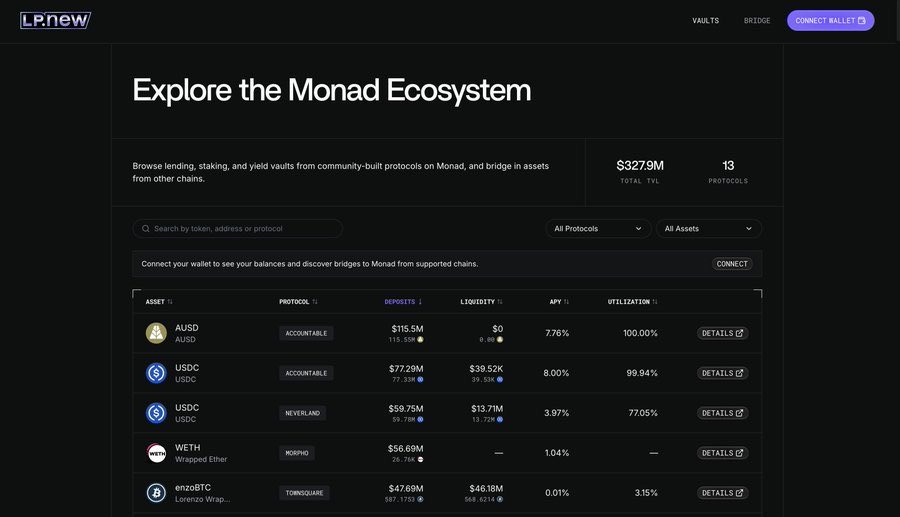
Check out https://t.co/kZ8AiyIGMH, a read-only interface for exploring liquidity pools, bridge routes, and yield data across the Monad ecosystem. https://t.co/l29oClVMw6


 7.6K @HarryAlford3
 Check out https://t.co/kZ8AiyIGMH, a read-only interface for exploring liquidity pools, bridge routes, and yield data across the Monad ecosystem. https://t.co/l29oClVMw6
 28
28
 5
5
 855
855
 2.8K @rookie_of_Ph 2.8K @rookie_of_Ph
 I hope you read this completely
while I agree this is a complex situation and LZ Labs has legitimate fault in parts of this, a lot of the framing here is either technically inaccurate or strawmanning the actual design.
let me go through it properly.
1. the DVN/setConfig distinction is real and the Kelp story is not what it's been framed as
there are two distinct configurable layers in LayerZero V2 and conflating them is doing a lot of work in Zayn's argument:
setConfig: a 3/5 multisig that can upgrade send/receive libraries. this is a trust surface. protocols that care pin their libraries explicitly and make them immutable against the Endpoint (Ethena did this; https://t.co/bRuOTS2JX6 did this).
DVN selection: entirely app-owned, configured per chain per pathway via setConfig(). no LZ Labs permission required. no LZ Labs involvement unless you choose their DVN.
the "you can't build on LZ without trusting LZ" claim is directly falsified by what AUSD (@AgoraGovernance) did post-exploit: they went to 5/5
11
8
3.1K
 22.3K @alphagrowth1
 You can now use your $AUSD/ $USDC/ $USDT Balancer BPT as collateral to borrow $AUSD on @monad.
Live on https://t.co/GDd5VZGA04.
Powered by @eulerfinance.
 154.1K @Balancer
 LPs, your pool token just got a new use case.
The first Balancer LP (BPT) as collateral integration is live for the $AUSD/ $USDC/ $USDT pool on @monad.
Powered by @eulerfinance as the lending layer, curated by @alphagrowth1.
Here's how it works 🧵 https://t.co/zTmy4zxzg3
 13
1
2.1K
13
1
2.1K